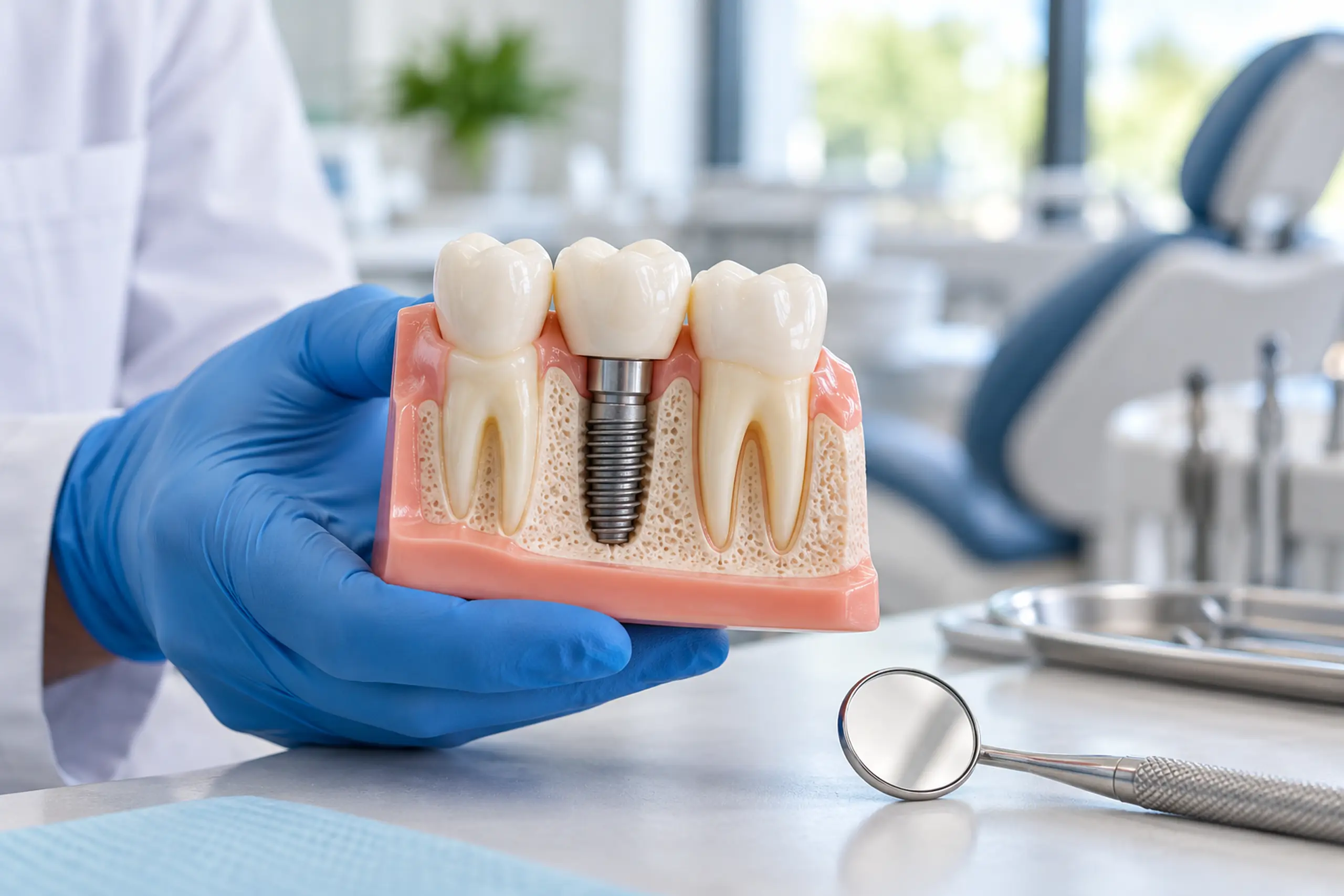
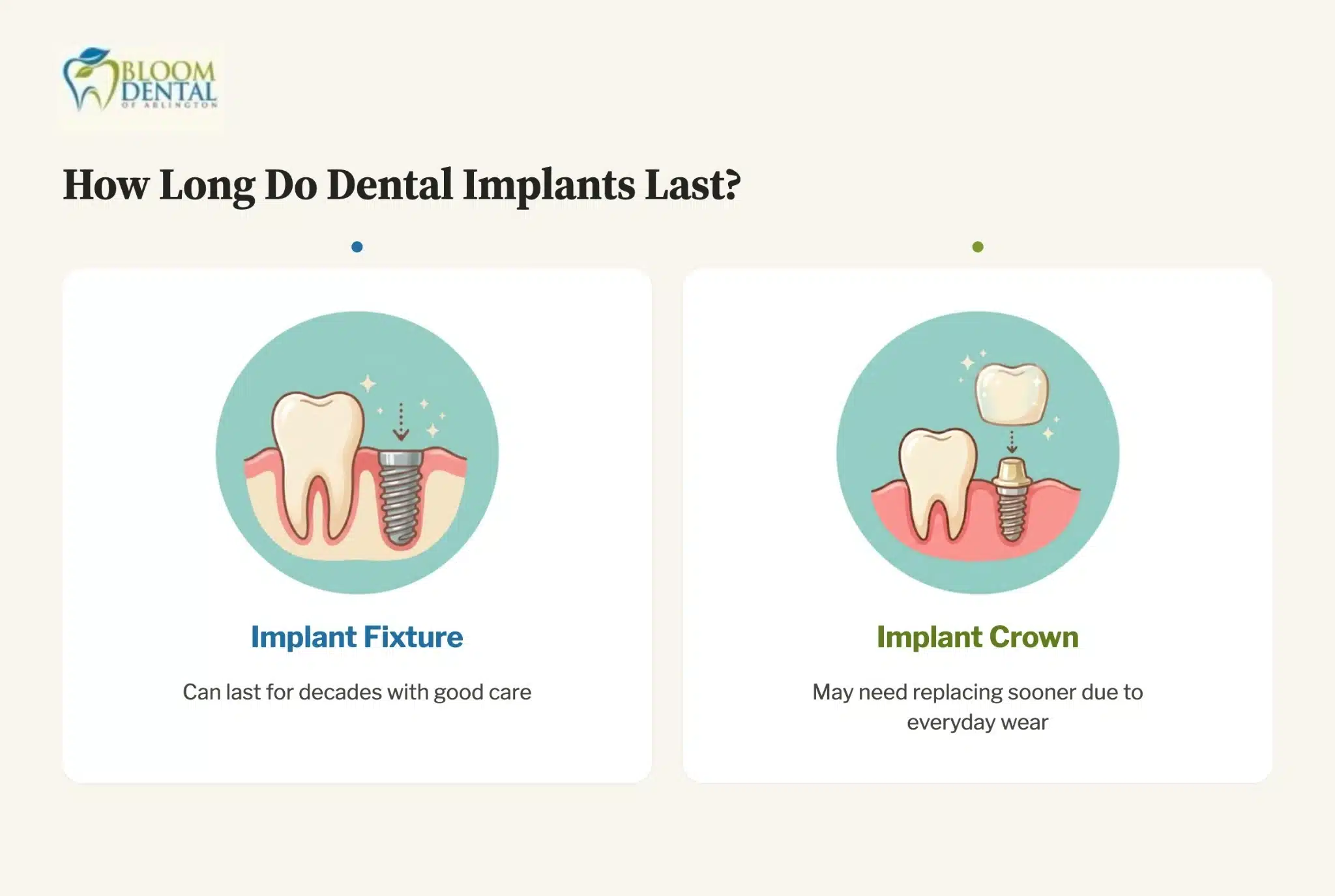
Implants are designed as long-term tooth replacements, and research shows most remain in place for at least ten years, but no individual implant can be guaranteed for life. It helps to separate the implant fixture, the post anchored in the jaw, from the crown attached to it, because the two do not necessarily share the same lifespan. Any change in how an implant looks or feels should be checked by a dentist.
Table of Contents
Are Dental Implants Permanent?
In clinical terms, the fixture is intended to remain integrated with the jawbone indefinitely, but permanent does not mean maintenance free. The crown and connecting parts may need repair or replacement, and the surrounding gum and bone need ongoing care. Whether dental implants last forever depends entirely on the individual. In practice, most long-term maintenance involves the parts above the gum, not the fixture itself.
What Is the Average Life of Dental Implants?
No single figure captures the average life of dental implants, because results vary with follow-up period, patient health, implant site, and study design. Survival means the implant is still in the mouth, which differs from success, a stricter measure, while failure usually means the implant is lost or removed. A systematic review of 18 studies estimated that 93 to 96 percent of implants survived ten years. Those figures describe groups of patients in clinical studies, so they show how long implants last on average and cannot predict the result for any one person.
Each component of the implant has its own outlook, as the table shows.
| Component | What it does | What can affect longevity | May need replacement or maintenance? |
| Implant fixture | Anchors in the jawbone | Gum and bone health, smoking, bite forces | Uncommon, but monitoring is ongoing |
| Crown | Provides the chewing surface | Wear, chipping, grinding, hygiene | More likely over time |
How Long Do Implant Crowns Last?
Implant crowns tend to need attention sooner than the fixture beneath them. In a systematic review of single implants followed for at least ten years, about 95 percent of implants were still in place, compared with about 90 percent of the original crowns. Porcelain can wear or chip, the screw or cement holding the crown can loosen, and heavy bite forces or poor hygiene around the crown add to the strain. There is no fixed replacement interval, and a worn crown can usually be remade without disturbing a healthy fixture.
What Affects Dental Implant Lifespan?
Dental implant lifespan is shaped by health and habits as much as by the implant itself. The American Academy of Periodontology lists poor plaque control, smoking, diabetes, and previous gum disease as risk factors for disease around implants, and other factors matter too.
- Oral hygiene and plaque control
- Smoking or other tobacco use
- History of periodontal disease
- Diabetes and how well it is controlled
- Implant position and bite loading
- Teeth grinding, which a meta-analysis linked to roughly double the odds of implant failure
- Condition of the crown and regular professional maintenance
Dental implants longevity therefore varies from person to person. Several of these factors can be changed, which is why a dentist reviews them both before and after an implant is placed.
Dental Implant Failure Rates and Long-Term Survival
Published dental implant failure rates are low over ten years, yet late problems occur, most often from inflammation around the implant. Recognizing the signs of dental implant failure, such as looseness or persistent pain, and treating a dental implant infection early improves the chance of keeping the implant. The American Academy of Periodontology describes two forms of this inflammation: peri-implant mucositis, which affects only the gum and may be reversible if caught early, and peri-implantitis, in which the supporting bone is also lost.
Studies do not all measure the same outcome, which is why published figures can look inconsistent. Research on implants usually reports one of three results: survival, success, or failure. Survival only means the implant is still in the mouth, success means it is also healthy and trouble free, and failure means it has been lost or removed. A survival rate will therefore tend to look better than a success rate for the same group of patients, and a figure quoted without its definition can make implants sound more or less dependable than they are. The table below sets out what each term means and why the difference matters when reading any statistic about implants.
| Outcome measure | What it means | Why it matters |
| Survival | The implant is still in the mouth at follow-up | It is the figure most studies report, but it includes implants that have problems |
| Success | The implant is present and also meets set criteria, such as stable bone and no pain or infection | It is a stricter measure, so success rates can be lower than survival rates |
| Failure | The implant has been lost or removed | Early failure happens before the implant bonds with the bone, and late failure happens after it has been in use |
Long-Term Care for Dental Implants
Long term care for dental implants involves the following steps.
- Brush twice daily and clean around the implant and between teeth.
- Attend maintenance visits on the schedule your dentist recommends.
- Have gum and bone health monitored.
- Wear a night guard if one is advised for grinding.
- Avoid tobacco.
No single visit interval suits everyone, so the maintenance schedule is set according to gum health, risk factors, and the type of restoration.
Bleeding, swelling, pus, or a loose implant should be examined promptly. Rapidly spreading facial swelling, fever, or difficulty swallowing or breathing requires urgent care.
How to Help Dental Implants Last as Long as Possible
Helping an implant last means looking after three things together: the fixture, the gum and bone around it, and the crown. In practice, that involves using the interdental brushes or floss recommended for the implant, keeping maintenance appointments even when nothing feels wrong, reporting bleeding or a change in the bite early, and managing conditions such as diabetes with a physician. These steps improve the outlook, although they cannot guarantee how long implants last.
Why Choose Bloom Dental of Arlington
Patients considering dental implants in Arlington receive an individual assessment at Bloom Dental of Arlington, including the health factors that influence how durable dental implants are likely to be. We’re happy to help: reach out today.
Frequently Asked Questions
Can a dental implant fail after 10 or 20 years?
Yes. Late failure is uncommon but possible, usually from inflammation and bone loss around the implant or from excessive bite forces, which is why long-term monitoring matters.
Does the dental implant or the crown usually need replacement first?
Usually the crown or its connecting parts. Research on single implants shows that original crowns are replaced more often than the implants supporting them.
Can dental implants get cavities?
No. Implants and their crowns are not made of tooth structure, so they cannot decay. The surrounding gum and bone can still develop inflammatory disease, and neighboring natural teeth can still get cavities.
Do dental implants last longer than bridges or dentures?
They can, but the comparison depends on the situation. Implants do not rely on neighboring teeth for support, while outcomes for any option depend on health, hygiene, and maintenance.
Does smoking shorten dental implant lifespan?
It can. Smoking is a recognized risk factor for disease around implants, and stopping tobacco use supports long-term gum health.
Can an implant crown be replaced without replacing the implant?
In most cases, yes. If the fixture is healthy and stable, a worn or damaged crown can typically be replaced on the existing implant.
What happens if a dental implant becomes loose?
Contact a dentist promptly and avoid chewing on it. The cause may be a loose crown or screw, which is often repairable, or loss of supporting bone, which needs timely treatment.
Can Dental Implants Last a Lifetime?
Some do, and good care improves the odds, but no implant can be guaranteed for life. How long tooth implants last depends on health, habits, and maintenance.