

One of the most common questions patients ask when exploring tooth replacement options is: How long does a dental implant procedure take? The entire process varies depending on each patient’s individual health, bone density, and treatment needs, but understanding each phase helps patients feel confident and prepared from initial consultation through final restoration.
Dental implants are the closest modern dentistry has come to replacing missing teeth with something that functions like your natural teeth, and while the surgical procedure itself is efficient, the full dental implant process is staged to protect long-term oral health and the integrity of the jawbone.
Table of Contents
The Initial Consultation and Treatment Planning
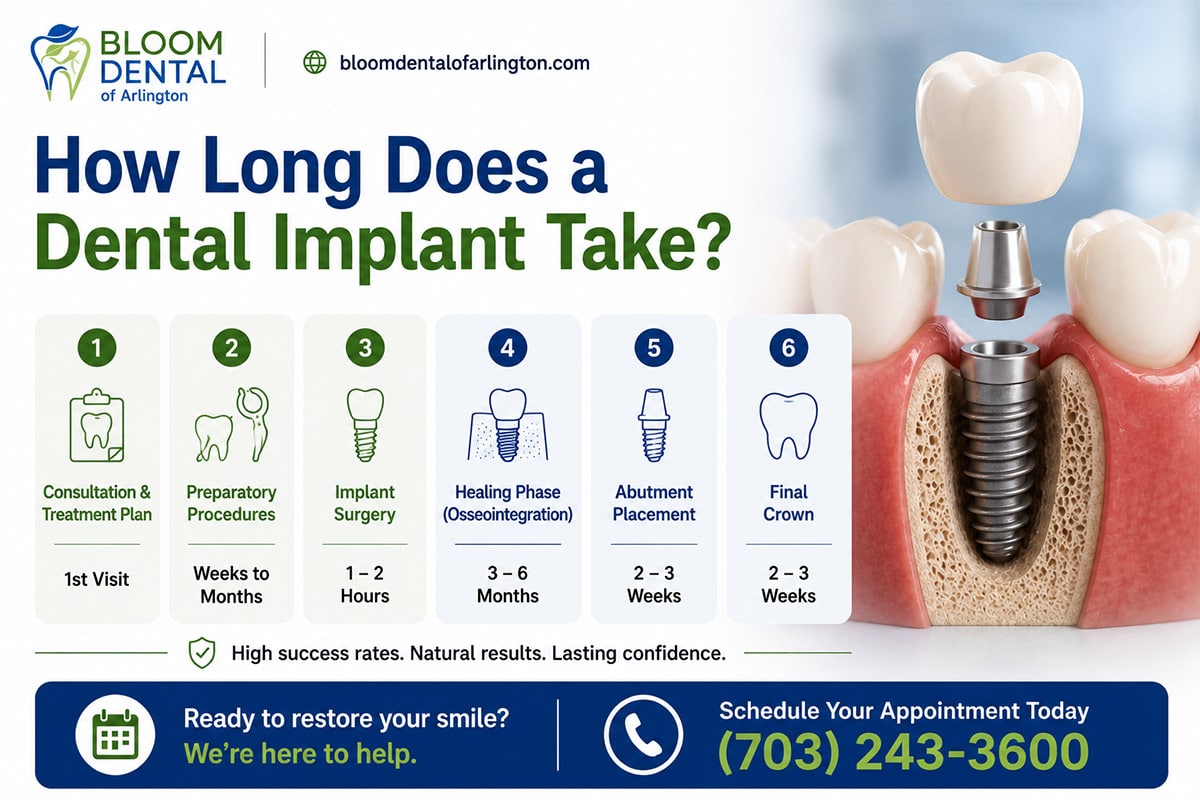
The first step in the implant journey is a thorough initial consultation at your dental office. During this first visit, your implant dentist or oral surgeon will review your complete medical history, assess your overall health, and examine the condition of your jawbone and gum tissue. Advanced imaging tools such as CT scans are used to evaluate bone density, identify existing bone loss, and map the implant site with precision, forming the foundation of a personalized treatment plan tailored to your dental care goals.
Preparatory Procedures Before Implant Placement
For some patients, the next step after consultation involves preparatory procedures. If a damaged or failing natural tooth remains at the implant site, a tooth extraction will be required. In certain cases, extraction and dental implant surgery can be performed on the same day, though many patients require a separate healing period of several weeks before placement can begin.
Patients with insufficient bone volume may need bone grafting before a titanium implant can be placed. Bone grafting rebuilds the foundation of the jawbone so that it can support the artificial tooth root securely. In cases where the upper jaw lacks adequate height, a sinus lift may also be necessary.
While these preparatory steps add time to the overall process, they are critical to achieving a stable, lasting result. Healing after a bone graft can take several months depending on the extent of bone loss and the patient’s overall health.
The Dental Implant Surgery Itself
The surgical procedure for a single dental implant is more straightforward than many patients anticipate. Dental implant placement typically takes 1 to 2 hours under local anesthesia and involves positioning a small titanium post, the artificial tooth root, directly into the jawbone at the prepared implant site. In some cases, a temporary tooth can be placed the same day, a protocol commonly referred to as same-day or day implants, and a healing cap is attached to protect the surgical area and guide the surrounding gum tissue as it heals.
Your implant dentist or oral surgeon will determine which approach is most appropriate based on your health conditions and the condition of your jawbone at the time of surgery.
The Healing Phase: Osseointegration and What It Requires
The healing phase is the most time-consuming part of the whole process, and also the most critical. During this period, the titanium implant fuses with the surrounding bone through a biological process called osseointegration. This integration is what gives dental implants their exceptional stability and allows them to function like natural teeth under normal biting forces.
In healthy, non-smoking patients, long-term studies report success rates for single implants in the 90 to 95 percent range after several years, which reflects how reliably this healing process performs when supported by good oral hygiene and regular check-ups.
The healing time for osseointegration typically ranges from 3 to 6 months, depending on the patient’s overall oral health, health conditions, and adherence to proper care instructions. A soft food diet, consistent oral hygiene, and attendance at scheduled follow-up appointments all support a smooth healing process and reduce the risk of complications.
Abutment Placement and the Final Dental Crown
Once osseointegration is complete, the next step is abutment placement. A small connector piece, called an abutment, is attached to the top of the implant and serves as the anchor for the final restoration. This minor procedure is followed by a brief additional healing period to allow the gum tissue to settle around the abutment before impressions are taken.
The final step is the placement of a custom-made dental crown designed to match the color, shape, and size of the surrounding teeth. This new tooth completes the implant process and restores full chewing function and a natural-looking smile. For patients replacing a single tooth, the result is a single tooth implant that is virtually indistinguishable from the adjacent natural teeth.
Why Choose Bloom Dental of Arlington
At Bloom Dental of Arlington, our team guides patients through every stage of the implant journey with individualized dental care, from the initial consultation and personalized treatment plan to surgical procedure, healing phase, and final restoration. We combine clinical expertise with genuine attention to each patient’s health conditions, goals, and long-term oral health.
If you have experienced tooth loss and are ready to explore your tooth replacement options, we invite you to schedule an appointment today with our Arlington implant team. Informed decisions about your smile start with a conversation, and we are here to answer every question along the way.